
The Kemetic Prayers: Part 2
The Noon Prayer
The second prayer of the day is noon, when the sun stands at its zenith. At dawn, Ra emerges renewed from the underworld: hawk-headed, vigorous, the force of arising. By noon, however, the sun has reached its apex: maximum heat, maximum light, maximum power. This is no longer the emerging warrior but power made manifest — power radiant, power that must now be received.
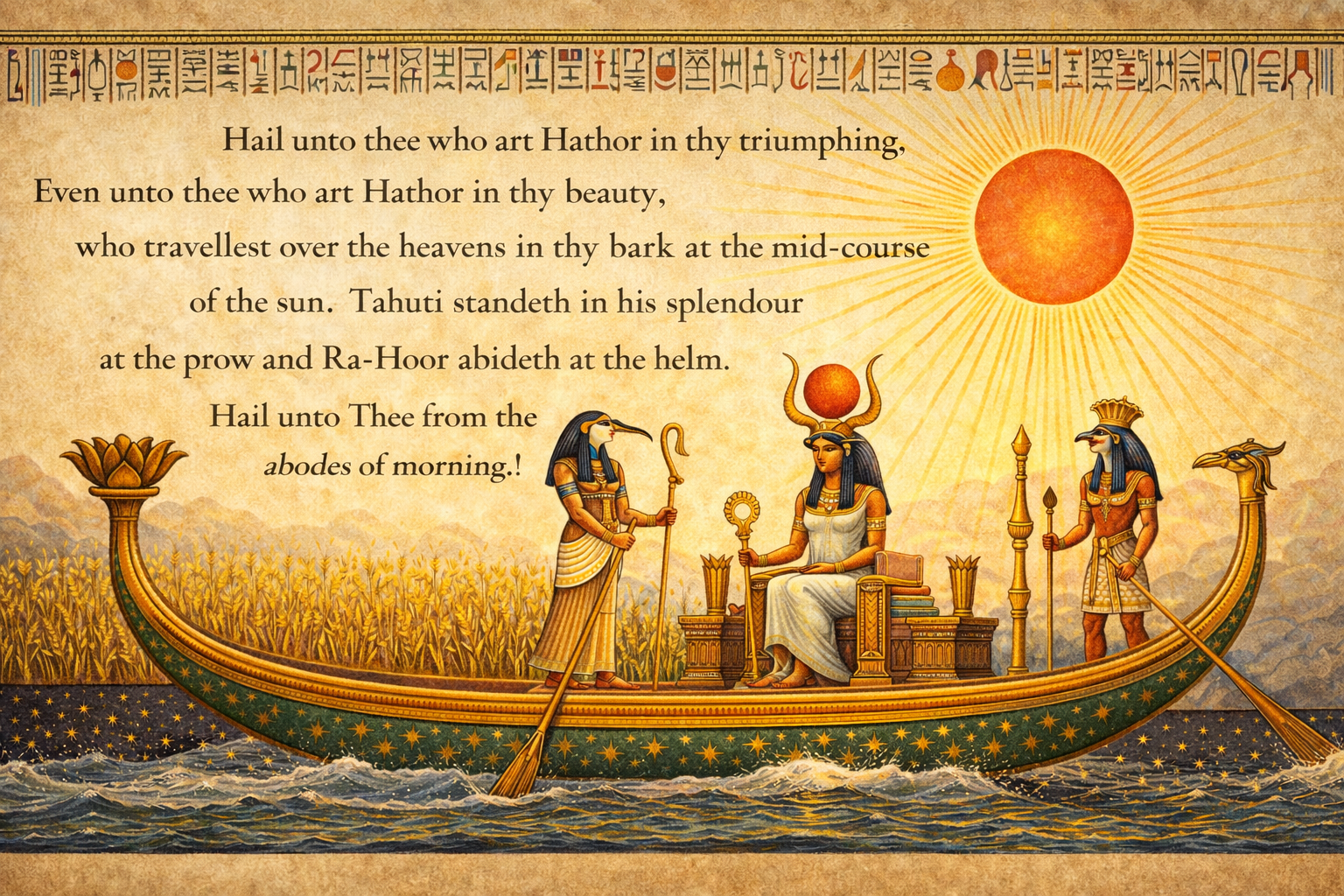
“Hail unto thee who art Hathor in thy triumphing.
Even unto thee who art Hathor in thy beauty,
who travellest over the heavens in thy bark at the mid-course of the sun.
Tahuti standeth in his splendour at the prow
and Ra-Hoor abideth at the helm.
Hail unto thee from the abodes of morning.”
Hathor is the Eye of Ra returned. The solar eye — the active force of Ra — can separate, become destructive as Sekhmet, and must be pacified to return as loving, life-giving power. By noon, the eye has completed its morning journey and now pours down in full benevolence. Hathor is solar power domesticated into joy: the golden light that ripens crops, intoxicates the senses, brings music, fertility, and relational warmth.
In Jungian terms, this is the zenith of ego-consciousness: the Self wearing a face that can be loved. Hathor is not power alone but power that attracts. Beauty here is not cosmetic; it is coherence. The cosmos appears beautiful because, for a moment, it is whole.
The morning prayer corresponds to the psyche’s act of rising and gathering strength — potential becoming. The noon prayer corresponds to triumph and beauty — potential realised.
The bark has reached its apex. This is not struggle but crowning. Hathor wears the solar disk between cow horns: the feminine vessel that contains and directs masculine fire. The prayer marks the moment when solar force becomes available for reception rather than merely observed in ascent. To adore Hathor is not to praise a decorative goddess but to tune consciousness to life at full intensity: relationships, creativity, sensual presence, the body moving through space with confidence and joy. It is a devotional way of saying: May I receive and radiate this fullness of life without shame or diminution. Noon becomes an exercise in standing in one’s power while remembering its impermanence and its place within a greater order.
The worshipper now speaks from the completed dawn journey. They have travelled with Ra, witnessed the transformation, and arrived at harvest. The sequence of prayers tracks the soul’s movement through the hours: emerging with the sun, arriving with the sun at zenith, descending with the sun thereafter. The worshipper is not static; they are in the bark and being shaped by its passage.
Thoth still measures and speaks, but now his reckoning is one of fulfilment. Horus still steers, but the horizon is now all directions, already inclining toward the western descent. Their persistence signals continuity of function through change of context. Symbolically: your speech and symbolic mind (Tahuti) and your directive will (Ra-Hoor) must still govern life when things are abundant and pleasurable. At dawn they initiate; at noon they regulate success and enjoyment so alignment is not lost.
Hathor’s name, Het-Heru — “House of Horus” — reveals her as the container of the royal solar child. At noon, the sun is fully housed in the sky’s zenith, completely incarnate. She is also Lady of the West, receiver of the dead, meaning that even at the height of triumph the prayer carries awareness of descent. Beauty here is transient beauty, to be received and transformed.
If morning is sublimation — the raising of matter — noon is fixation: the moment of maximum concentration before dissolution begins. Hathor’s presence declares: this is the hour to receive, to drink, to be filled. The prayer invites participation in radiance, not detached observation.
Midday is thus theophany: divinity so manifest it must be met with feminine receptivity. The force invoked in strength must now be embraced in beauty. Ra at dawn calls you to rise with him; Hathor at noon invites you to enter her house.
Mid-course is equilibrium. The bark sails the meridian of consciousness, where above and below are in perfect counterpoise. The soul is neither ascending nor descending but abiding.
The inner movement is therefore this: at dawn, you align with the will to arise (Ra). At noon, you align with the joy of fully being here (Hathor), without severing pleasure from holiness. Mind (Tahuti) and will (Ra-Hoor) are called to steer that joy so it becomes radiant presence rather than egoic excess.
“Hail unto thee from the abodes of morning.”
This line is subtle and exquisite. Noon does not forget dawn. Consciousness remembers its birth. The splendour of midday remains rooted in the humility of arising. Alchemically, gold remembers lead. Mythically, illumination carries the scent of its origin. This guards against inflation — the Jungian error of mistaking solar insight for personal greatness.




Disclaimer:
AI was used as a neurodivergent aid tool for editing and reflection; all synthesis, interpretation, and voice remain fully my own.
