
The Kemetic Prayers: Part 3
The Sunset Prayer
“Hail unto Thee, who art Turn in Thy setting, even unto Thee who art Atum in Thy joy, who travellest over the Heavens in Thy bark at the Down-going of the Sun. Tahuti standeth in His splendour at the prow, and Ra-Hoor abideth at the helm. Hail unto Thee from the Abodes of Day!”
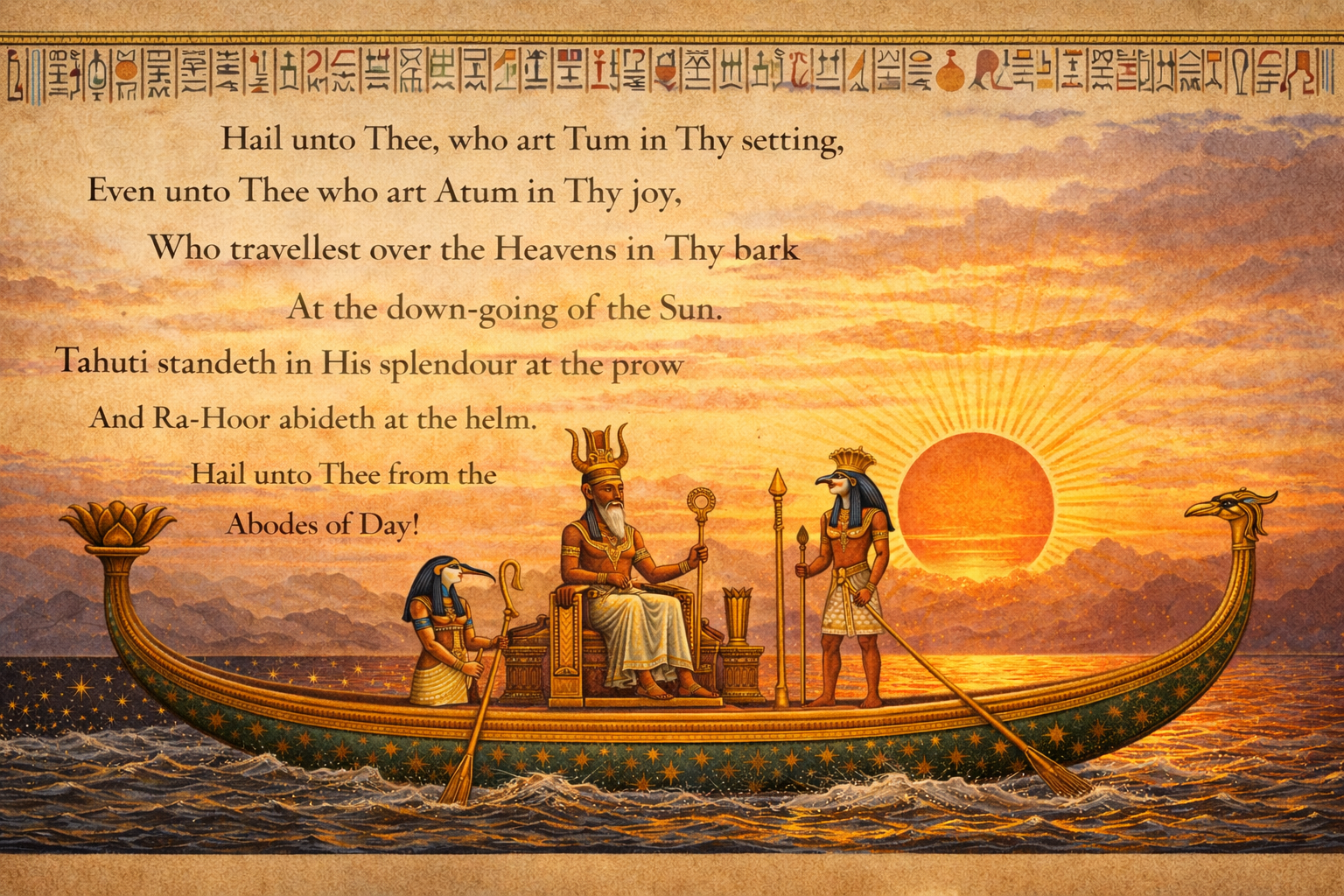
The bark moves westward, toward the unseen. Direction matters: west is the land of ancestors, memory, myth. Where noon was equilibrium, sunset is surrendered asymmetry: light tilts, shadows lengthen, meanings soften. Consciousness loosens from outer objects and turns inward. This is solutio: forms dissolve back into the waters from which they were precipitated, not as loss but as delight. The prayer trains the soul not to resist this liquefaction. Sunset teaches how to end well.
Atum is not merely another solar form. He is the undifferentiated source, self-created from Nun, who now re-enters the watery realm willingly, carrying the day’s harvest. “In Thy joy” is crucial: this is no tragic sinking but a voluntary return, the voluptas of the Philosopher’s quiet completion, distinct from Hathor’s noon intoxication. The fixed dissolves toward the volatile; the essence gathers into the vessel of origin. Setting is coagulation, not failure.
Thoth at the prow now faces the western horizon: judgment, the weighing of hearts, entry into the Duat. His measurement here is final accounting: has the day been lived in Ma’at? Horus steers into the akhet, the liminal zone where opposites interpenetrate. The helm turns downward; the steering is toward depth. Their persistence through all three prayers reveals the subtle teaching: even in descent - when light wanes, certainties fade, you “lose control”- the guiding intelligences of word and will remain present, if you choose to remember them. Sovereignty is proven not by conquest but by how one withdraws. Kingship that cannot descend is tyranny; solar masculinity that cannot soften becomes brittle.
You speak now from the completed day, from fullness passing. This is the position of the successful operator: one who has been present for the solar transformation, who stands in the place of harvest to witness the return. “As above, so below” has been lived; now the below addresses the above from its own completion. If morning was sublimation and noon fixation, sunset is fermentation: the introduction of the completed material into the vessel where it will undergo putrefaction, the nigredo preceding rebirth. Atum’s joy is the joy of one who knows: this death is my own design, this return my renewal.
“Hail unto Thee from the Abodes of Day!” acknowledges that what you praise is departing. You bless the movement into night rather than cling to fading light. The bark does not sink; it enters. The Egyptian underworld is not below but within, behind the horizon; penetration into the hidden, the beginning of nocturnal Work that yields the transformed Ra of dawn.
To live this: deliberately let the day’s persona die a small death. Acknowledge what was done, offered, or failed. Give it back to the Sun in joy, not clinging or self-recrimination. Trust that its essence will be carried through the invisibility of night.




Disclaimer:
AI was used as a neurodivergent aid tool for editing and reflection; all synthesis, interpretation, and voice remain fully my own.
