
The Kemetic Prayers: Part 1
The Morning Prayer
As a child, I remember contemplating the meaning of prayer. Not merely the prescribed movements and utterances of Islamic practice, but something deeper: the significance of each sound, each gesture, each posture, and what they were meant to represent. Even then, I sensed that prayer was a technology of mind, heart, soul, and body; not a series of motions to be repeated without comprehension. Yet repetition was what was expected: five times a day, even when meaning had thinned into obligation.
As I grew older, I turned my attention to prayer in other cultures and religions and discovered both striking differences and unmistakable continuities. What remained constant was rhythm: the cadence of recitation, the structuring of time, and the alignment of prayer with the sun’s movement across the sky. Human activity was organised around these moments, mirroring the psychological states that unfold throughout the day. This confirmed for me that prayer was never something offered to the gods alone; it was something given to the self; a structure, inner and outer, imposed upon a psychic landscape most of us barely perceive.
What transformed my understanding entirely was the study of how my ancestors prayed. Prayer was not merely communication between human and divine; it was an alchemical technology. Alchemy, for them, was not confined to temples or ritual occasions; it was a continuous practice, operative at every hour. Prayer belonged to this science of transformation.
This is the first of four parts examining the four daily prayers practised by my ancestors. Read through an alchemical and Hermetic lens, they reveal the layers of meaning my six-year-old self was already searching for.
The first is the morning prayer, traditionally recited at dawn, before sunrise:
“Hail unto thee who art Ra in thy rising, even unto thee who art Ra in thy strength,
Who travellest over the heavens in thy bark.
At the uprising of the sun, Tahuti standeth in his splendour at the prow and Ra-Hoor abideth at the helm.
Hail unto thee from the abodes of night.”
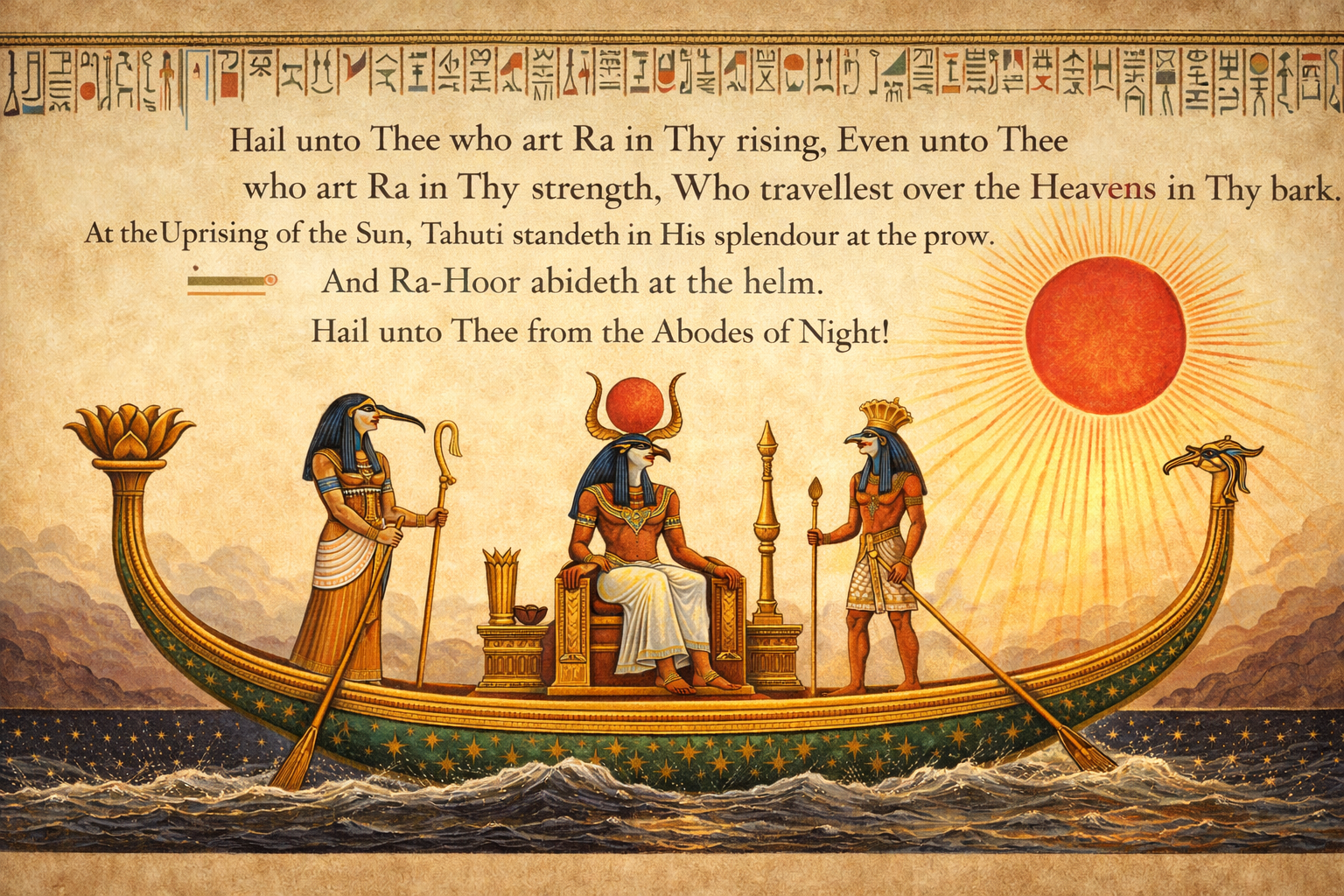
The first image encountered is the solar bark. There were two: the night boat, Meqet, and the morning boat, Mandjet. Together they symbolised the soul’s passage through the Duat, the underworld and the world of the living. The Duat was not reserved for the afterlife; it was traversed daily. To visualise Ra’s bark was not to observe it but to participate in its transformation. The bark carries the dead through the night and the living through the day, suggesting that prayer operates simultaneously across multiple planes of existence, dissolving the boundary between practitioner and cosmic cycle.
Here prayer is visualisation; an early technology of active imagination. Thoth stands at the prow, the cutting edge where what is unknown is first met. Word precedes power. Creation advances by articulation before command. Thoth is the measurer and recorder of outcomes, the one who inscribes the soul’s judgement. His position reveals that the morning prayer is not only praise but divination. At dawn, the day’s possibilities are still being written. Through visualisation, the practitioner aligns with Thoth’s function: measuring, knowing, speaking reality into form.
The speaker emerges from darkness, from the underworld journey completed in sleep. The prayer marks a threshold: the soul has travelled with Ra through the night, faced Apophis, and now stands renewed at the eastern gate. This is not a greeting of the sun but a declaration of resurrection. The Islamic Fajr prayer carries a similar movement from darkness into light, yet the Egyptian formulation explicitly acknowledges survival of the underworld passage.
Ra-Hoor at the helm governs direction. Horus of the Horizon is the perfected royal soul: the avenger of Osiris, the hawk-eye that sees from above. At the helm he represents not only indwelling divinity but the axis of will itself; the steering of consciousness toward horizon-wide vision. The will of God becomes the mechanism of direction.
Egyptian prayer possessed an initiatory depth: not all prayers were equal, and some required conscious descent into the shadow realm.
The Eye of Ra is not passive sight. It is the wedjat; active, protective, and sometimes destructive. It goes forth, burns enemies, and returns transformed. The solar eye may become Sekhmet and devastate, or return pacified as Hathor. The prayer therefore carries a current of danger. The same force that illumines also judges.
Prayer in Kemet was not recitation but cosmic maintenance. By speaking the bark’s journey, one participates in ensuring Ra’s passage and thus the continuity of Ma’at. Islamic prayer preserves this structure of praise as cosmic participation, yet the Egyptian system is explicit in its use of imaginal technology.
Texts indicate multiple identifications were possible: one could pray as passenger in the bark, as crew, as Ra himself, or as observer on the shore. The phrase “abodes of night” implies speech from the underworld itself; identification with the transformed soul rather than the static worshipper. The sun that rises is not the sun that set; both it and the practitioner have been altered by the night journey.
Through a Jungian lens, the bark becomes the ego moving through states of consciousness. Morning is the psyche emerging from the Duat of dream into daylight awareness. To anchor the mind to the bark is to stabilise identity upon a divine trajectory rather than a merely personal one. The prayer becomes daily re-ensoulment: one does not awaken as oneself but as a passenger of Ra. Consciousness is experienced as movement rather than abstraction.
Hermetically, the prayer does not mirror heaven; it installs it. The bark sails because it is imagined. The sun rises because the mind consents to its symbolism. This is subtle theurgy: reality sustained by rhythmic contemplation.
Islam expresses this through aniconic unity; Kemetic prayer through a multiplicity of forms. Ra, Khepri, Atum, Horus are not separate gods but facets of a single solar intelligence. Image, word, and cosmic event form one continuum.
These prayers were daily re-enactments of cosmogenesis. Each dawn, the universe was made again, first in symbol, then in soul, then in sun. The Eye of Ra signifies the non-conceptual luminosity of awareness itself: both merciful and uncompromising. The prayer becomes an act of remembrance: I live within the gaze of the One, and that gaze lives as my capacity to witness.
The aim was not emotional devotion alone but alignment of inner pattern with greater order.
In the next parts, each prayer will be examined according to its solar station:
Dawn: birth, emergence, fresh possibility
Noon: full power, clarity, engagement
Sunset: relinquishment, fruit fading into rest
Midnight: gestation, transformation in darkness
Praying the same formula across these stations trains recognition that the same Ra moves through all phases without diminution. Prayer was never directed toward the external sun alone, but toward the continuity of inner divinity through change.
Note: The wording of this prayer is an English adaptation drawing upon older solar hymns and temple theology, belonging to a modern esoteric current commonly called Liber Resh.
End of Part One.
In other news:
I am very excited to announce that I’ll be running my first activation retreat in Cairo, Egypt, from 30th April - 4 May. It is called: The Return of Isis - a 5 day activation of the divine feminine principles within every woman. As we are all witnessing the scale of death the collective is going through, it becomes incumbent upon us to lead the way towards harnessing life and joy within us for our children and their future. May we co-create a world that is centred upon our children and their joy and never anything else.
You can find more information about the retreat here.
Disclaimer:
AI was used as a neurodivergent aid tool for editing and reflection; all synthesis, interpretation, and voice remain fully my own.
