What Astrology Taught Me
That No Higher Degree in Psychology Ever Could
Astrology taught me that human life is not random, nor is it purely self-authored. What it reveals, above all else, is story: the narrative architecture through which consciousness moves. A birth chart does not predict events in a simplistic or mechanical way; it maps the myth the psyche is already inhabiting. It shows the terrain, the motifs, the conflicts, and the characters, but not the final resolution.
Astrology reveals the timelines the main character will walk through and the divine principles anchored into the vessel at birth. It shows what was already in motion before we arrived; psychologically, emotionally, and symbolically. Birth itself is not a neutral event. The chart reflects the emotional climate of the parents, the psychic atmosphere of the family system, and the way the soul experienced being received into the world. Long before language or memory, meaning was already being formed.
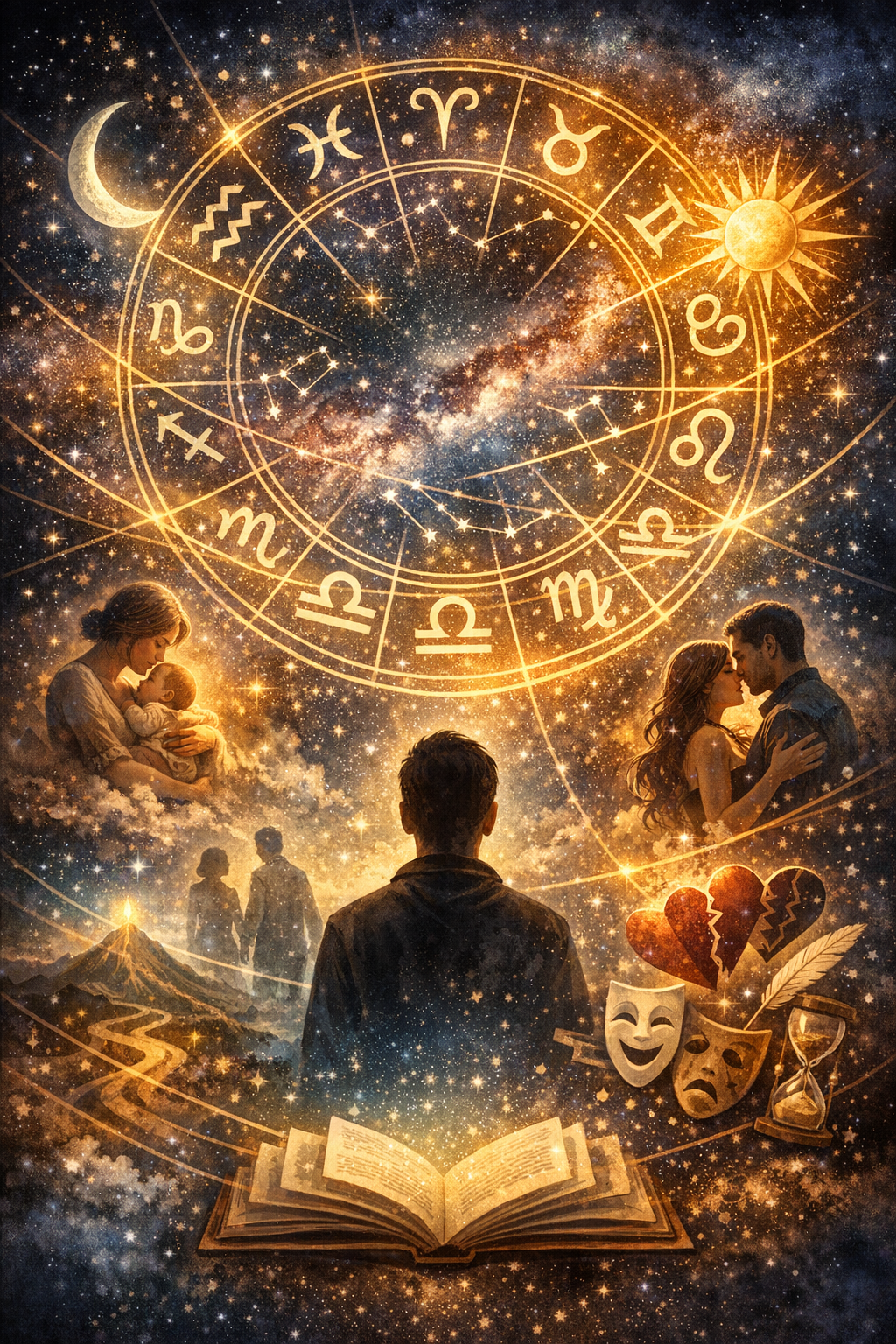
From a psychological perspective, this is not mystical speculation. It aligns directly with depth psychology. As Carl Jung understood, the psyche enters life pre-shaped by archetypal patterns. Astrology offers a symbolic language for those patterns. It reveals how the individual perceived their parents; not as objective figures, but as internal images. This distinction matters. Siblings, raised in the same household, never experience the same mother or father. Each child encounters a different archetype, filtered through their own psyche. Astrology makes this visible.
The chart also reveals the challenges we are likely to face, not as punishments or accidents, but as necessary tensions through which consciousness develops. Saturn shows where maturation is demanded. Pluto shows where transformation is unavoidable. Venus and Mars reveal how we love, desire, pursue, and withdraw. These are not moral judgments; they are descriptions of psychological gravity.
Astrology shows direction but not method. It reveals where the psyche is oriented, not how it must arrive there. The future is suggested in symbolic terms - through the Sun, the lunar nodes, and planetary cycles - but the manner of living those symbols remains a matter of consciousness. Fate, in this sense, is not what happens to us. It is the pattern we are born into. Freedom lies in how consciously we engage it.
It also shows how we are seen and how we see ourselves, often two very different realities. The ascendant describes the mask we wear and the impression we leave, while the Sun and Moon describe identity and emotional truth. Much of human suffering arises from confusing these levels, from mistaking appearance for essence or expectation for truth.
Astrology even reveals what compels us and what undoes us. It shows how we fall in love—and often when—not as a romantic fantasy, but as an archetypal inevitability. It reveals repetition: the kinds of lovers we choose, the dynamics we replay, the wounds we touch and reopen. These patterns persist until they are made conscious. Without awareness, the chart is lived blindly. With awareness, it becomes a tool for integration.
Yet the most important lesson astrology teaches is not predictive at all.
It teaches that no two people inhabit the same story.
How we see our own narrative, how we understand others’ involvement in it, and how they understand their role within it are never identical. There is no shared, objective reality between psyches; only overlapping symbolic worlds. This insight dismantles the typical ways we measure relationships: compatibility, chemistry, effort, intention. These metrics assume a neutral reality that does not exist.
From both an astrological and psychological perspective, this assumption is false. Jung called this projection: we meet our inner figures in the outer world and mistake them for the people standing in front of us. Astrology shows this symbolically. Two charts interacting do not produce a single experience; they produce at least two, often more. Each person experiences the relationship through their own archetypal lens.
This is why love does not guarantee harmony, why desire does not ensure longevity, and why good intentions so often fail. Relationships are not negotiations between facts; they are encounters between myths. Conflict frequently arises not from malice, but from incompatible symbolic realities.
Seen this way, astrology exposes a humbling truth: we are not the authors of the story we are living. The structure precedes us. The archetypes are already in place. What many call God, others call psyche, cosmos, or logos: different names for the same ordering intelligence that patterns meaning into existence.
Astrology does not remove responsibility; it deepens it. If we are not responsible for the story we entered, we are fully responsible for how consciously we live it. Awareness does not change the myth, but it changes our relationship to it. And that difference determines whether the story is lived unconsciously, compulsively, and painfully - or consciously, creatively, and with dignity.
Astrology, at its highest level, is not about control. It is about recognition. It teaches us to see the story we are already in and to take responsibility for how we carry it forward.